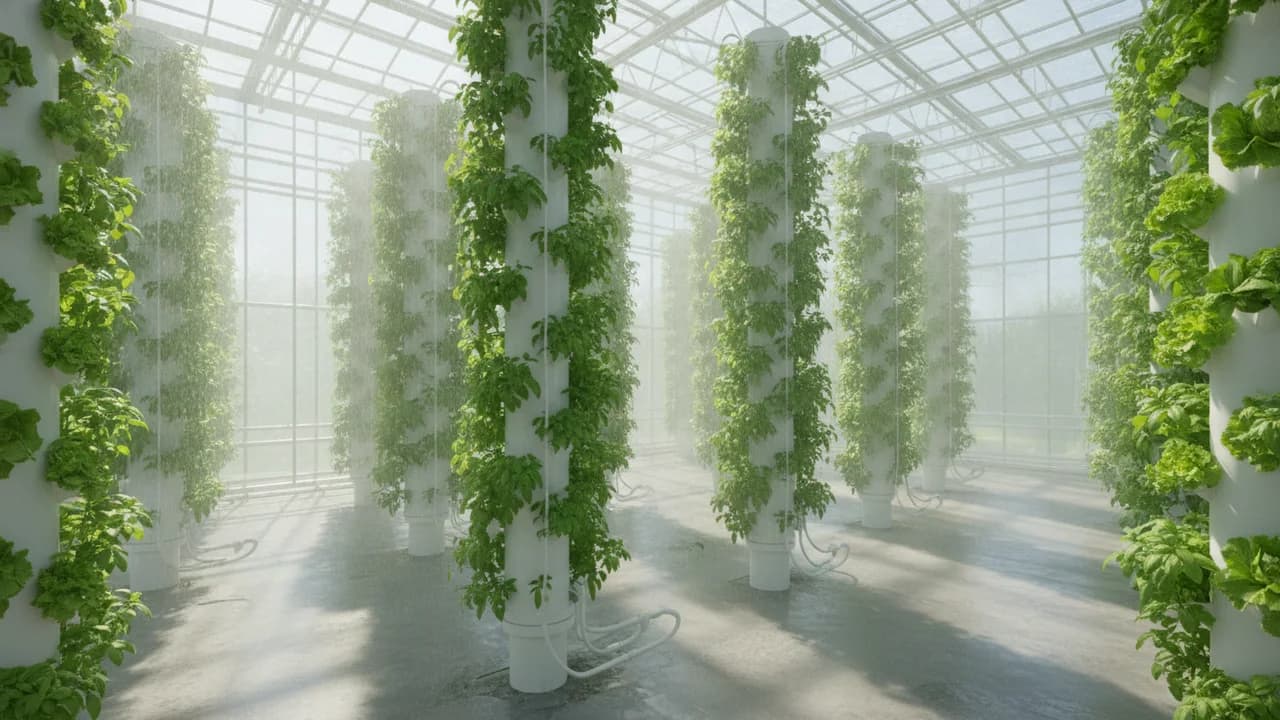
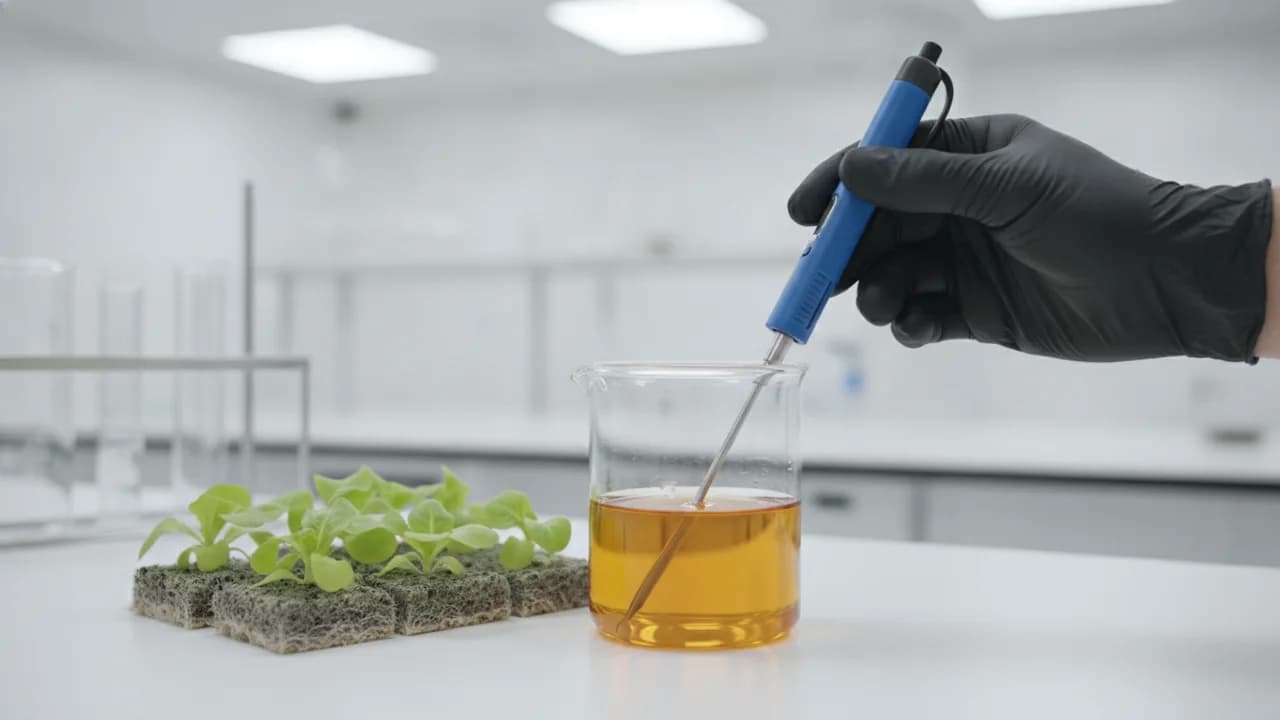
In hydroponics there is no soil to buffer your mistakes. The plant depends entirely on the nutrient solution you prepare for it, and two numbers decide whether that solution feeds or starves your plant: pH (acidity) and EC (electrical conductivity). Understanding these two parameters is the difference between lush growth and mysteriously yellowing leaves you cannot explain.
This guide explains what pH and EC actually measure, which values are ideal for individual crops, how to measure and precisely adjust them, and how to recognise and solve the most common problems. All values refer to vertical hydroponic towers, NFT, DWC and other recirculating systems.
What is pH and why is it critical in hydroponics
pH is a measure of the acidity or alkalinity of a solution on a scale from 0 to 14. A value of 7 is neutral, below 7 the solution is acidic, above 7 alkaline (basic). The scale is logarithmic — meaning pH 5 is ten times more acidic than pH 6 and a hundred times more acidic than pH 7. That is why even a small change in the number means a large chemical change.
In hydroponics, pH does not act on the plant directly but controls the solubility and availability of nutrients in the solution. Each element (nitrogen, phosphorus, potassium, iron, manganese...) is most available within a specific pH range. When pH leaves that range, nutrients chemically bind into forms the root cannot absorb, even if there is plenty of them in the tank. This phenomenon is called nutrient lockout.
For most hydroponic plants the ideal pH range is 5.5 to 6.5. Within this narrow window both the macronutrients (N, P, K, Ca, Mg) and the micronutrients (Fe, Mn, Zn, B, Cu) are simultaneously most soluble and available. When pH rises too high (above 7.0), the first symptom is usually iron deficiency — young leaves yellow between the veins (chlorosis) even though there is plenty of iron in the solution. When pH drops too low (below 5.0), toxicities and deficiencies of other elements can appear.
What is EC (electrical conductivity)
EC (electrical conductivity) measures how well a solution conducts electricity, which depends directly on the total concentration of dissolved nutrient salts. The more dissolved fertiliser (salts) in the water, the higher the conductivity. EC is therefore not a measure of quality or nutrient ratios — it is a measure of the overall STRENGTH of the solution. The standard unit is mS/cm (millisiemens per centimetre); the same value is also expressed as dS/m (decisiemens per metre): 1 mS/cm = 1 dS/m.
EC is often converted to PPM or TDS (total dissolved solids, parts per million). The conversion is not universal because there are different scales: on the 500 scale (NaCl, US meters) EC 1.0 mS/cm ≈ 500 ppm, while on the 700 scale (KCl, European/Hanna meters) EC 1.0 mS/cm ≈ 700 ppm. Always check which scale your meter uses before comparing your value to a table on the internet — otherwise you are off by 40%.
Too low an EC means the plant lacks food — growth is slow, leaves pale. Too high an EC means too much salt in the solution: water leaves the root osmotically instead of entering it, and the plant "dries out" even though it floats in water. The consequences are salt stress, brown and burnt leaf edges (tip burn), wilting and stalled growth. Young plants and leafy greens require a lower EC, while fruiting crops such as tomato and pepper tolerate and demand a considerably higher one.
| EC (mS/cm) | PPM scale 500 | PPM scale 700 | Interpretation |
|---|---|---|---|
| 0.5 | 250 | 350 | Very weak — seedlings, microgreens |
| 1.0 | 500 | 700 | Mild — young leafy greens, herbs |
| 1.5 | 750 | 1050 | Moderate — lettuce in full growth |
| 2.0 | 1000 | 1400 | Strong — spinach, fruiting crops in growth |
| 2.5 | 1250 | 1750 | Very strong — tomato, pepper in fruit |
| 3.0 | 1500 | 2100 | Maximum — mature fruiting crops |
Large reference table: optimal pH and EC per plant
The following table gives proven, common ranges for the most frequent hydroponic crops. The values are a guide for healthy growth — we recommend beginners aim for the middle of the range, while experienced growers can fine-tune according to growth stage and cultivar. Note that a lower EC within the range often delivers better quality and flavour, while a higher EC pushes for maximum yield (with a greater risk of salt stress).
| Plant | Optimal pH | Optimal EC (mS/cm) |
|---|---|---|
| Lettuce / head lettuce | 5.5 – 6.5 | 1.2 – 2.0 |
| Spinach | 6.0 – 7.0 | 1.8 – 2.3 |
| Swiss chard | 6.0 – 7.0 | 1.8 – 2.3 |
| Arugula (rocket) | 6.0 – 7.0 | 1.2 – 1.8 |
| Basil and herbs | 5.5 – 6.5 | 1.0 – 1.6 |
| Tomato | 5.5 – 6.5 | 2.0 – 3.5 |
| Cucumber | 5.5 – 6.0 | 1.7 – 2.5 |
| Pepper | 5.5 – 6.5 | 2.0 – 3.0 |
| Strawberry | 5.5 – 6.2 | 1.0 – 1.4 |
| Microgreens | 5.5 – 6.5 | 0.5 – 1.2 |
How to measure pH and EC
Without measuring you are working blind. There are two basic instruments: the pH meter and the EC meter (often combined in one combo device or separate). Digital meters are fast and precise but need care — above all, regular calibration.
- pH meter: the digital pen gives a reading in seconds. Calibrate it with solutions of known value (buffer pH 4.0 and pH 7.0) at least once a week, and keep the electrode moist (never dry!) in storage solution.
- EC meter / TDS meter: measures conductivity. It is calibrated with a standard solution (e.g. 1.41 mS/cm). Check whether it uses the 500 or 700 scale for the PPM display.
- pH test drops / test strips: a cheap colour-based backup method. Less accurate than the digital meter, but useful for a quick check or as a control when you suspect a faulty meter.
- Solution temperature: many quality meters have automatic temperature compensation (ATC). EC rises with temperature, so without compensation you measure incorrectly — the reference temperature is usually 25 °C.
How often to measure? In small systems and towers, check pH and EC daily or every other day. Fast-growing plants change the solution quickly — they take up water at a different rate than nutrients, so both pH and EC constantly shift. In larger, stable systems two to three times a week may be enough. Always measure at the same time of day so the values are comparable.
How to adjust pH and EC
Adjusting pH
If pH is too high (solution too alkaline), you lower it with pH-Down (usually phosphoric or nitric acid). If pH is too low, you raise it with pH-Up (usually potassium hydroxide or potassium carbonate). Add a small amount, stir well, wait a few minutes and only then measure again. Acids act strongly — better two small corrections than one too large that throws you into the other extreme.
Adjusting EC
If EC is too high (too much salt), dilute the solution by adding clean water — this lowers the concentration. If EC is too low, add concentrated nutrient (fertiliser) per the manufacturer instructions to raise the concentration. Important order rule: adjust the EC first (add fertiliser or water) and ONLY THEN the pH, because adding fertiliser changes the pH by itself. The reverse order means you will have to correct the pH twice.
Common mistakes and troubleshooting
Most problems in hydroponics come down to pH or EC being out of range. The following table links the symptom to the likely cause and the solution.
| Symptom / problem | Likely cause | Solution |
|---|---|---|
| pH keeps rising (upward drift) | Plant takes up acids / nitrates quickly; soft water without buffer | Measure more often; gradual small pH-Down corrections; more stable nutrient |
| pH keeps falling | High root activity; breakdown of organic matter | Correct with pH-Up; check tank cleanliness |
| Yellow veins on young leaves (chlorosis) | pH too high → iron locked out | Lower pH to 5.8–6.0; check Fe level |
| Brown, burnt leaf edges (tip burn) | EC too high — salt stress | Dilute solution with clean water; lower EC |
| Slow growth, pale leaves | EC too low — nutrient deficiency | Add nutrient up to the target EC |
| White salt deposits on the system/medium | Water evaporation, salt build-up, high EC | Top up with clean water; occasionally flush the system with clean water |
| EC rises on its own between top-ups | Plant takes up more water than salt | Top up with clean water (no fertiliser) to bring the EC back |
A special case is pH drift — the constant shifting of pH between two measurements. Minor fluctuations are normal because the plant takes up ions selectively. It only becomes a problem when pH leaves the 5.5–6.5 range. In small systems the drift is more pronounced because the solution volume is smaller and the buffering capacity weaker; the solution is more frequent measuring and small, gradual corrections rather than one large one.
Water for hydroponics: the starting point
The quality of the water you fill the system with determines how much work you will have with pH and EC. Ideally you start from water with a low intrinsic EC (below 0.5 mS/cm), because then you control every added gram of salt yourself. Hard tap water already contains dissolved minerals (calcium, magnesium, carbonates) that both raise the starting EC and buffer the pH upward — that is why hard water often needs adjusting. Reverse osmosis (RO) provides nearly pure water (EC close to 0), an ideal starting point, but requires a complete nutrient because it contains neither calcium nor magnesium.
FAQ
Why does my pH keep fluctuating (drift)?
Can I use tap water?
What does PPM mean and how does it relate to EC?
What pH is ideal if I grow several different plants together?
Should I lower the EC during summer heat?
How often should I completely change the nutrient solution?
Sources
- Sulaiman H, Yusof AA, Mohamed Nor MK (2025). Automated Hydroponic Nutrient Dosing System: A Scoping Review of pH and Electrical Conductivity Dosing Frameworks. AgriEngineering (MDPI). mdpi.com/2624-7402/7/2/43
- Scientific Reports (2026). Interactive effects of electrical conductivity and light intensity on growth, yield, and nutrient dynamics of hydroponic lettuce. Nature. nature.com/articles/s41598-026-44508-2
- Water (2025). Impact of Water pH and Cultivar on Lettuce Growth, Water Use Efficiency, and Nutrient Use Efficiency in Deep Water Culture Systems. MDPI. mdpi.com/2073-4441/17/17/2637
- USDA-ARS (2020). Effects of EC, pH, and Foliar Application of Calcium Chloride on Yield and Tipburn of Lactuca sativa Grown in NFT. ars.usda.gov
- Sonneveld C, Voogt W (2009). Plant Nutrition of Greenhouse Crops. Springer.
- Canadian Journal of Plant Science (2023). Current perspective on nutrient solution management strategies in hydroponic systems. cdnsciencepub.com/doi/10.1139/cjps-2023-0034