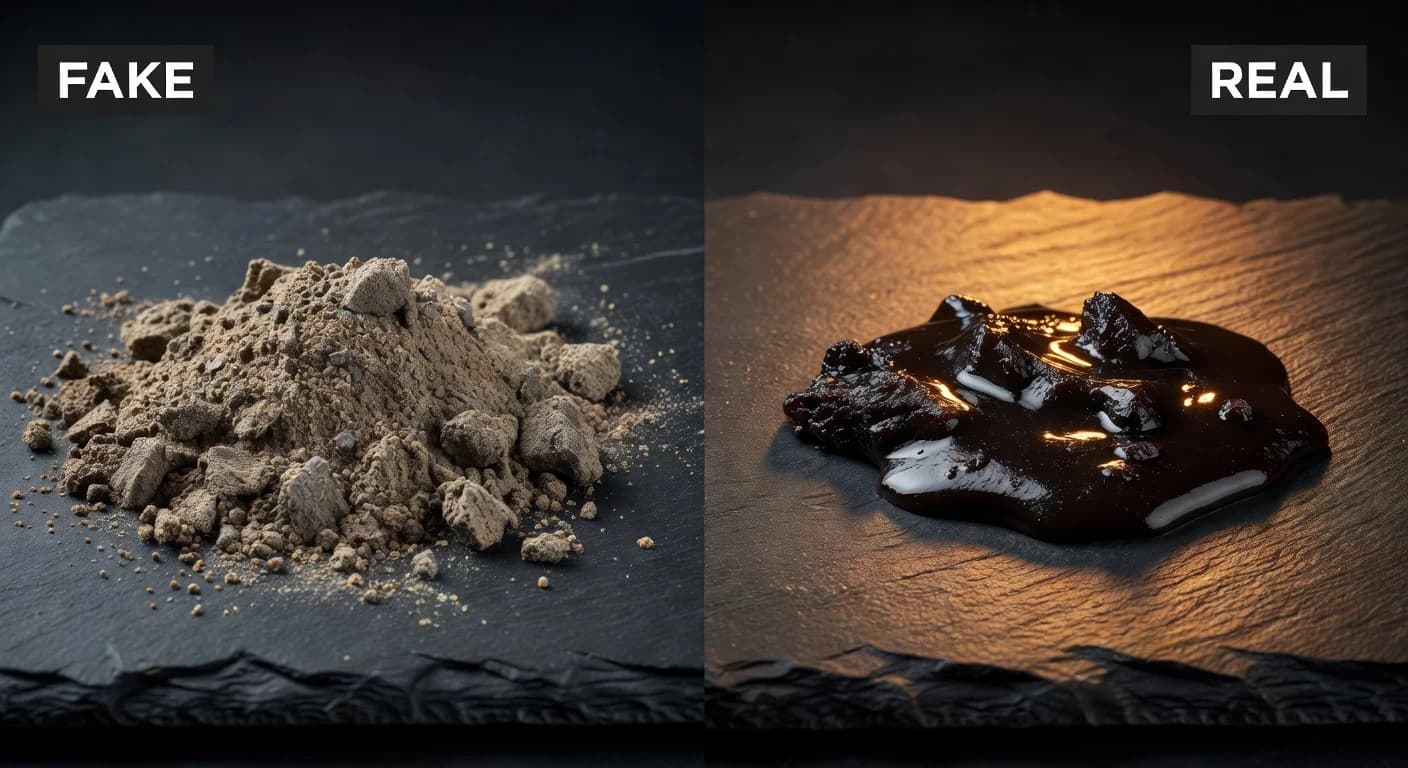
"85–90% of shilajit products on the market are fake, contaminated, or improperly processed." — International Journal of Agriculture and Biology, 2024.
Shilajit has become one of the most popular natural supplements worldwide. With rising popularity came a wave of counterfeits that aren't just ineffective – they can be dangerous to health.
The Shocking Scale of the Problem
| Category | Market Share | Description |
|---|---|---|
| Coal tar mixtures | 28% | Industrial waste processed to look like shilajit |
| Degraded/burnt shilajit | 22% | Improperly processed, no active compounds |
| Partially counterfeit | 10% | Real shilajit diluted with cheap fillers |
| Synthetic products | 33% | Completely artificial – no relation to real shilajit |
| Authentic shilajit | 5–7% | Real, pure Himalayan shilajit with lab tests |
6 Tests to Verify Authenticity
1. Water Solubility Test
Put some shilajit in a glass of warm water. Real shilajit dissolves completely, coloring the water dark brown to reddish-black with no residue at the bottom.
2. Flame Test
Heat some shilajit on a spoon over a flame. Real shilajit melts and bubbles but does NOT catch fire. Fake shilajit ignites immediately and smells like burnt rubber.
3. Flexibility Test
Hold shilajit in your hands for 30–60 seconds. Real shilajit becomes soft and sticky from your body heat. In the fridge, it becomes hard and brittle.
4. Smell Test
Real shilajit has a characteristic, intense earthy smell. Fake smells chemical or has no smell at all.
5. Alcohol Test
Real shilajit does NOT dissolve in alcohol – it remains solid. Fake shilajit dissolves in alcohol because it contains synthetic resins.
6. Milk Test
Add some shilajit to warm milk. Real shilajit dissolves completely and colors the milk golden-brown.
Our Shilajit: Complete Transparency
At faga.bio, we sell exclusively pure Himalayan shilajit that we personally harvest at altitudes above 4,000 meters. Each batch is lab-tested at ITC Lab (NABL certified laboratory).
| Parameter | Our Result | Standard |
|---|---|---|
| Fulvic acid | 70.95% | >60% |
| Total minerals | 85+ (14 lab-confirmed) | Minimum 10 |
| Lead (Pb) | Within EU limits | <3 mg/kg |
| Arsenic (As) | Within EU limits | <3 mg/kg |
| Mercury (Hg) | Within EU limits | <0.1 mg/kg |
| Cadmium (Cd) | Within EU limits | <1 mg/kg |
FAQ
Why is fake shilajit so widespread?
Can fake shilajit harm health?
Is shilajit in capsules always fake?
What's a fair price for real shilajit?
How can I verify a lab certificate?
Sources
- Kamgar E, Kaykhaii M, Zemberzuska J. (2023). A Comprehensive Review on Shilajit: What We Know about Its Chemical Composition. Crit Rev Anal Chem.. PMID: 38133965
- Satti MA, Rashid U, Bashir K, Shah A, Junaid M, Alamzeb M, Khan MI, Khan MS, Hussain A. (2024). Hazardous or Advantageous: Uncovering the Roles of Heavy Metals and Humic Substances in Shilajit (Phyto-mineral) with Emphasis on Heavy Metals Toxicity and Their Detoxification Mechanisms.. Biol Trace Elem Res.. PMID: 38393563
- Kamgar E, Kaykhaii M, Zemberzuska J. (2025). Quantifying of thallium in Shilajit and its supplements to unveil the potential risk of consumption of this popular traditional medicine.. J Trace Elem Med Biol.. PMID: 38245593
- Somadevan VS, Kumar NA, Suresh P, Kothapalli R, Chandana M. (2026). Shilajit-analytical study to understand the phyto complex present in shilajit raw material, extract and resin by using hyphenated techniques.. J Chromatogr A.. PMID: 41330163
- Al-Salman F, Ali Redha A, Al-Zaimoor Z, AlZahrani H, Al-Garni S, Soliman F, Al-Saif B, Aboul-Soud MA, Gondal MA. (2021). Rapid Determination and Quantification of Nutritional and Poisonous Metals in Vastly Consumed Ayurvedic Herbal Medicine (Rejuvenator Shilajit) by Humans Using Three Advanced Analytical Techniques.. Biol Trace Elem Res.. PMID: 34800280
Note: This article is for informational purposes only, does not constitute medical advice and does not replace consultation with a doctor. Consult a doctor before taking any food supplement — especially with chronic conditions, pregnancy or breastfeeding.