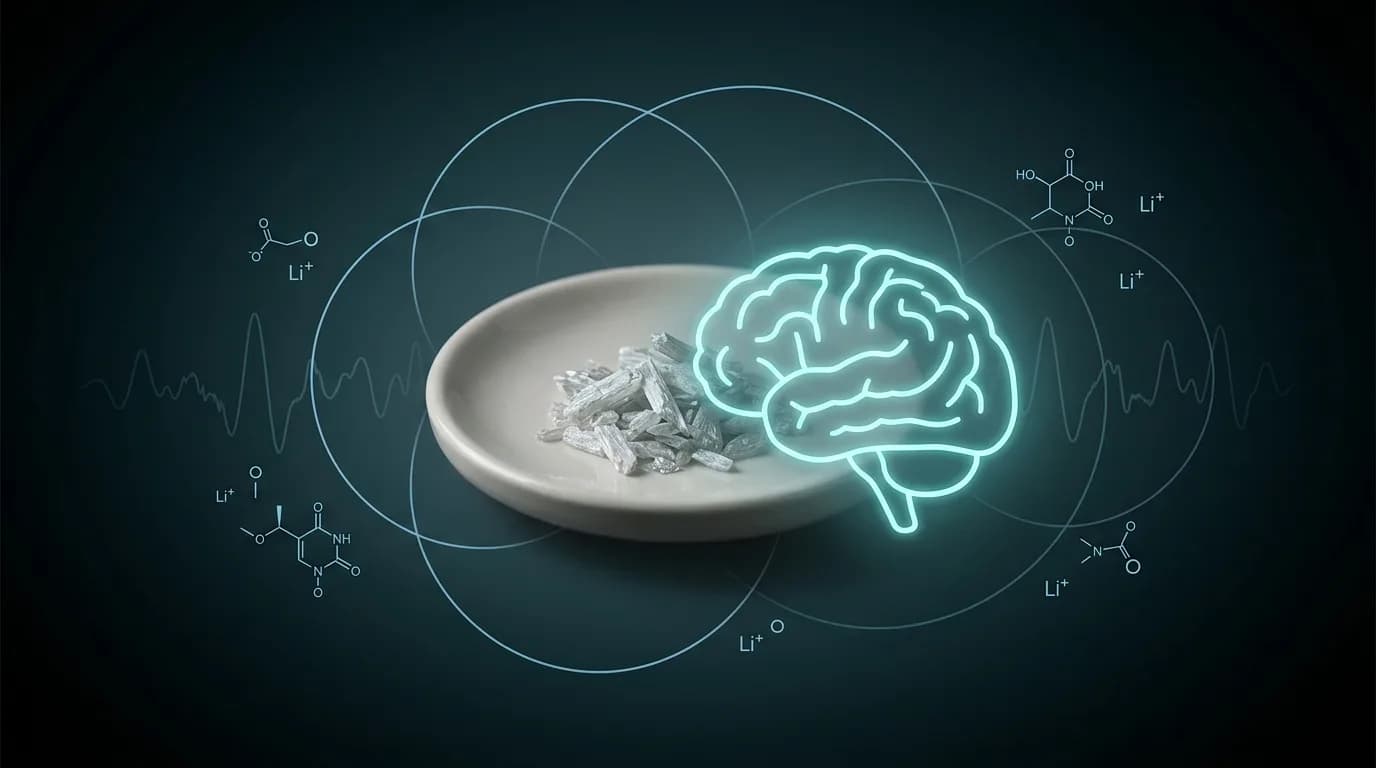
Lithium is a trace element naturally present in soil and water. While best known as a psychiatric medication (lithium carbonate, 300–1800 mg daily for bipolar disorder), recent years have seen growing interest in its low-dose form — lithium orotate, sold as a dietary supplement at doses of 5 to 20 mg elemental lithium.
Lithium Orotate vs. Lithium Carbonate — The Critical Difference
The biggest misconception about lithium orotate is confusing it with pharmaceutical lithium carbonate. They are two completely different approaches to the same mineral:
| Characteristic | Lithium Carbonate | Lithium Orotate |
|---|---|---|
| Elemental lithium dose | 150–450 mg daily | 5–20 mg daily |
| Prescription status | Prescription (medication) | Dietary supplement (US, EU) |
| Indication | Bipolar disorder, depression | Mood, sleep, cognition |
| Blood monitoring | Required (therapeutic range 0.6–1.2 mEq/L) | Not routinely required |
| Kidney load | Significant — can cause nephrotoxicity | Minimal at 5–20 mg |
| Thyroid | Hypothyroidism common | Rarely reported |
In other words: lithium carbonate is a high dose for severe psychiatric diagnoses under strict medical control. Lithium orotate is a dose comparable to natural intake through food and water (about 1–2 mg daily is already consumed via drinking water in some regions).
Why Orotate? What Makes It Special?
Lithium orotate is a lithium salt with orotic acid (vitamin B13). The theory — developed in the 1970s by Dr. Hans Nieper — states that orotate acts as a "mineral carrier" that more effectively crosses the blood-brain barrier. This would explain why smaller doses show effects comparable to higher doses of other lithium salts.
What Does Science Say About Low Lithium Doses?
Epidemiological research in several countries (Texas, Japan, Italy, Austria) has shown an association between higher natural lithium content in drinking water and:
- Lower suicide rates in the population
- Lower rates of violent crime
- Fewer cases of dementia and Alzheimer's disease
- Better overall mental health
- Greater longevity (controversial evidence — more studies underway)
Clinical research (Nunes et al., 2013, 2014): small lithium doses (300 µg daily) slowed cognitive decline in patients with Alzheimer's and mild cognitive impairment. Although those doses were lower than typical lithium orotate (5–20 mg), they point to a neurobiological basis for low-dose effects.
Mechanisms of Action
1. GSK-3β Inhibition
Lithium inhibits glycogen synthase kinase 3 beta (GSK-3β), an enzyme linked to neurodegeneration and mood disorders. This is likely the main mechanism of neuroprotection.
2. Increasing BDNF
BDNF (brain-derived neurotrophic factor) is "fertilizer for the brain" — a protein that promotes the growth of new neurons. Lithium increases BDNF levels, which explains potential effects on mood and cognition.
3. Glutamate Regulation
Lithium modulates glutamatergic systems, contributing to mood stabilization and reduction of neuroinflammation.
4. Circadian Rhythm
Lithium synchronizes the biological clock, which may explain subjective reports of better sleep among low-dose lithium users.
Who Might Benefit?
- People with mild anxiety or mood disorders (with doctor's approval)
- People with sleep problems related to mental overload
- Professionals with high mental stress
- Older adults concerned about cognitive health
- People with impulsivity or poor emotional regulation
Dosing (Informational Only)
| Level | Dose | Comment |
|---|---|---|
| Microdose | 1–5 mg elemental lithium | Beginner / sensitive individuals |
| Standard | 5–10 mg daily | Most common nutritional recommendation |
| Higher | 10–20 mg daily | Only with doctor consultation |
| Above 20 mg | Not recommended without blood tests | Approaching pharmaceutical zone |
Commercial products usually list the lithium orotate amount (e.g., 130 mg), which corresponds to approximately 5 mg elemental lithium (about 3.8% by mass). Always check how much elemental lithium is in the capsule.
Risks and Contraindications
- Existing thyroid disease — even low doses can affect hormone balance; periodic TSH monitoring recommended
- Kidney insufficiency — lithium is excreted by the kidneys; may accumulate with damage
- NSAIDs (ibuprofen, naproxen) — increase serum lithium levels
- ACE inhibitors and diuretics — similar
- Pregnancy — not safe (lithium carbonate use linked to malformations)
- Dehydration / fever — increases blood concentration
- Combination with SSRI antidepressants — may interact; monitor carefully
Possible Side Effects (Even at Low Doses)
- Mild hand tremor (rare at <10 mg)
- Dry mouth and increased thirst
- Mild metallic taste
- Frequent urination
- Fatigue or "dullness" during the first days (usually passes)
- Acne in sensitive skin (rare)
Lithium in Natural Diet
Lithium occurs naturally in soil and water, so also in foods:
- Mineral water from certain springs
- Leafy greens (especially grown on lithium-rich soils)
- Grains (oats, barley)
- Dairy products
- Potatoes and tomatoes
Lithium Orotate vs. Other Natural Mood Strategies
| Approach | Main Goal | Evidence Strength |
|---|---|---|
| Lithium orotate (low-dose) | Mood stabilization, neuroprotection | Moderate — epidemiological + early clinical |
| Ashwagandha | Cortisol, stress, anxiety | Strong — RCTs |
| Omega-3 (EPA/DHA) | Inflammation, mood, cognition | Strong — meta-analyses |
| Magnesium (glycinate) | Anxiety, sleep, GABA | Strong — clinical studies |
| Shilajit | Energy, cognition, vitality | Moderate — several RCTs |
| Vitamin D3 + K2 | Mood, immunity, bones | Strong — meta-analyses |
FAQ
Can I buy lithium orotate in Europe?
Do I need blood tests if I take low-dose lithium orotate?
Can I take it together with ashwagandha or magnesium?
How quickly are effects noticeable?
Can I take it with coffee?
Is it safe for long-term use?
Difference between lithium orotate, aspartate, citrate?
Sources
- Nunes MA, Viel TA, Buck HS (2013). Microdose lithium treatment stabilized cognitive impairment in patients with Alzheimer's disease. Current Alzheimer Research. PMID: 22746245
- Kessing LV, et al. (2017). Association of Lithium in Drinking Water With the Incidence of Dementia. JAMA Psychiatry. PMID: 28832903
- Schrauzer GN (2002). Lithium: occurrence, dietary intakes, nutritional essentiality. Journal of the American College of Nutrition. PMID: 11838886
- Forlenza OV, De-Paula VJ, Diniz BS (2014). Neuroprotective effects of lithium: implications for the treatment of Alzheimer's disease. ACS Chemical Neuroscience. PMID: 24697768
- Smith KA, Cipriani A (2017). Lithium and suicide in mood disorders: Updated meta-review of the scientific literature. Bipolar Disorders. PMID: 28739056
- Pacholko AG, Bekar LK (2021). Lithium orotate: A superior option for lithium therapy?. Brain and Behavior. PMID: 34743421
Note: This article is for informational purposes only, does not constitute medical advice and does not replace consultation with a doctor. Consult a doctor before taking any food supplement — especially with chronic conditions, pregnancy or breastfeeding.