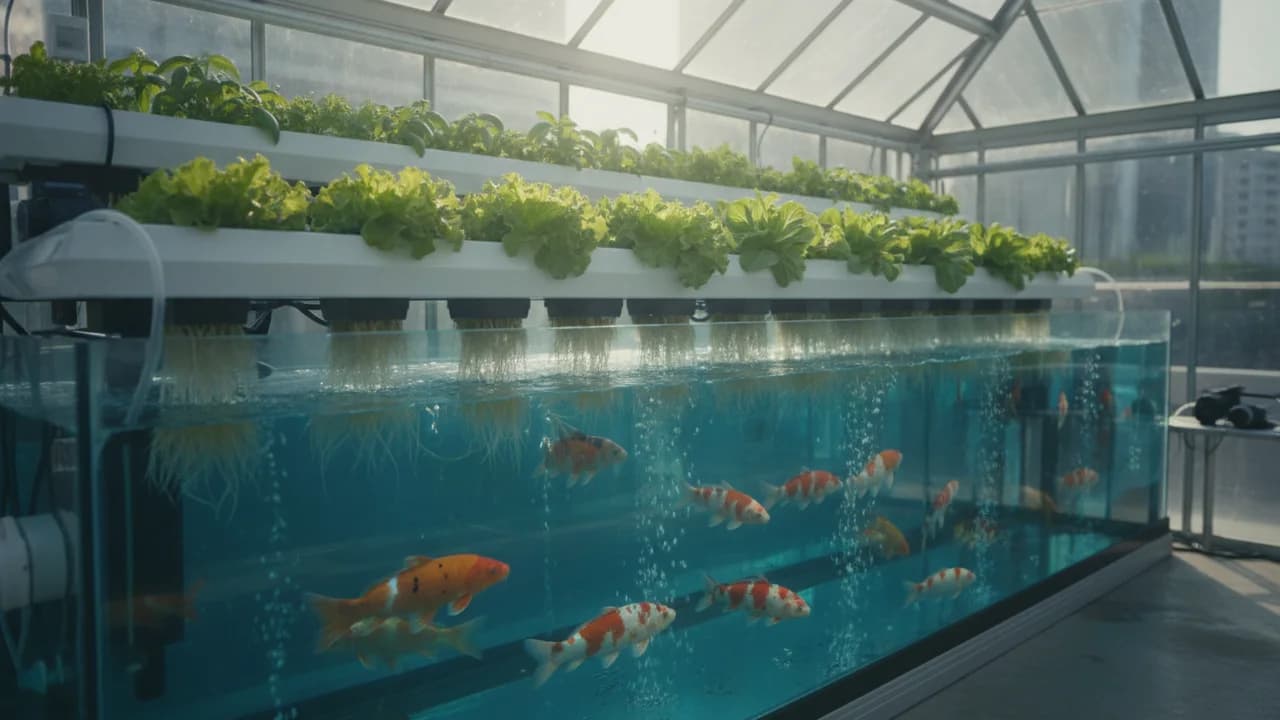
Aquaponics combines aquaculture (fish farming) with hydroponics (growing plants in water). Fish produce waste that bacteria convert into nutrients for plants. Plants filter the water that returns to the fish. A perfect cycle.
How Does Aquaponics Work?
Fish excrete ammonia. Nitrifying bacteria convert ammonia into nitrates – ideal fertilizer for plants. Plants absorb nitrates and clean the water that returns to the fish.
| Component | Function | Example |
|---|---|---|
| Fish tank | Home for fish | Tilapia, carp, trout |
| Biofilter | Bacteria convert ammonia | Clay balls |
| Growing bed | Plants grow in water | Lettuce, microgreens, herbs |
| Water pump | Circulates water | Solar or electric |
Advantages of Aquaponics
- 90% less water consumption
- No pesticides or herbicides
- Double yield – fish + vegetables
- Minimal space – works on a balcony
- Year-round growing – independent of season
Start Your Own Mini System
- Step 1: Set up aquarium (min. 80 liters) and add fish
- Step 2: Wait 4–6 weeks for bacteria to develop
- Step 3: Test water – ammonia must be 0, nitrates 20–40 ppm
- Step 4: Plant microgreens in growing beds
- Step 5: Feed fish, monitor pH (6.8–7.2), and enjoy
Aquaponics in Numbers
| Factor | Traditional | Aquaponics | Savings |
|---|---|---|---|
| Water | 100% | 10% | 90% less |
| Space | 100% | 25% | 75% less |
| Fertilizer | Purchased | Fish | 100% savings |
| Pesticides | Often needed | Impossible | 100% organic |
🌍 By 2030, 68% of the world's population will live in cities. Aquaponics is one answer to the question: how do you feed cities?
Sources
- Wirza R, Nazir S (2020). Urban aquaponics farming and cities- a systematic literature review. Rev Environ Health. PMID: 32885994
- Konrad A, Goddek S, Delaide B, Junge R, Schmautz Z, Maucieri C (2024). Assessing the fate and behaviour of plant nutrients in aquaponic systems by chemical equilibrium modelling: A meta-analytical approach. Water Res. PMID: 39151528
- Rakocy J, Masci T, Su Y, Daughs Z, Tursi C, Knoerdel M, Shultz R, Saez-de-Viteri M (2021). Improving Plant Health Through Nutrient Remineralization in Aquaponic Systems. Front Sustain Food Syst. PMID: 34164627
- Hassanien MH, El-Sayed AM, Abdel-Fattah MS, Abo-State H, Hussein H, El-Said HM (2024). Optimizing nutrient utilization, hydraulic loading rate, and feed conversion ratios through freshwater IMTA-aquaponic and hydroponic systems as an environmentally sustainable aquaculture concept. J Clean Prod. PMID: 38927906
- Sharma D, Kaviraj M, Kour D, Kaul S, Kumar V, Singh M, Kaur T, Aftab T, Bhardwaj R, Sharma S (2025). Integrated nutrient and feeding optimization strategies in aquaponics for sustainable urban food production and water conservation. Front Plant Sci. PMID: 39130768